





What is ERP Software and Why Does Your Business Need It in 2026?
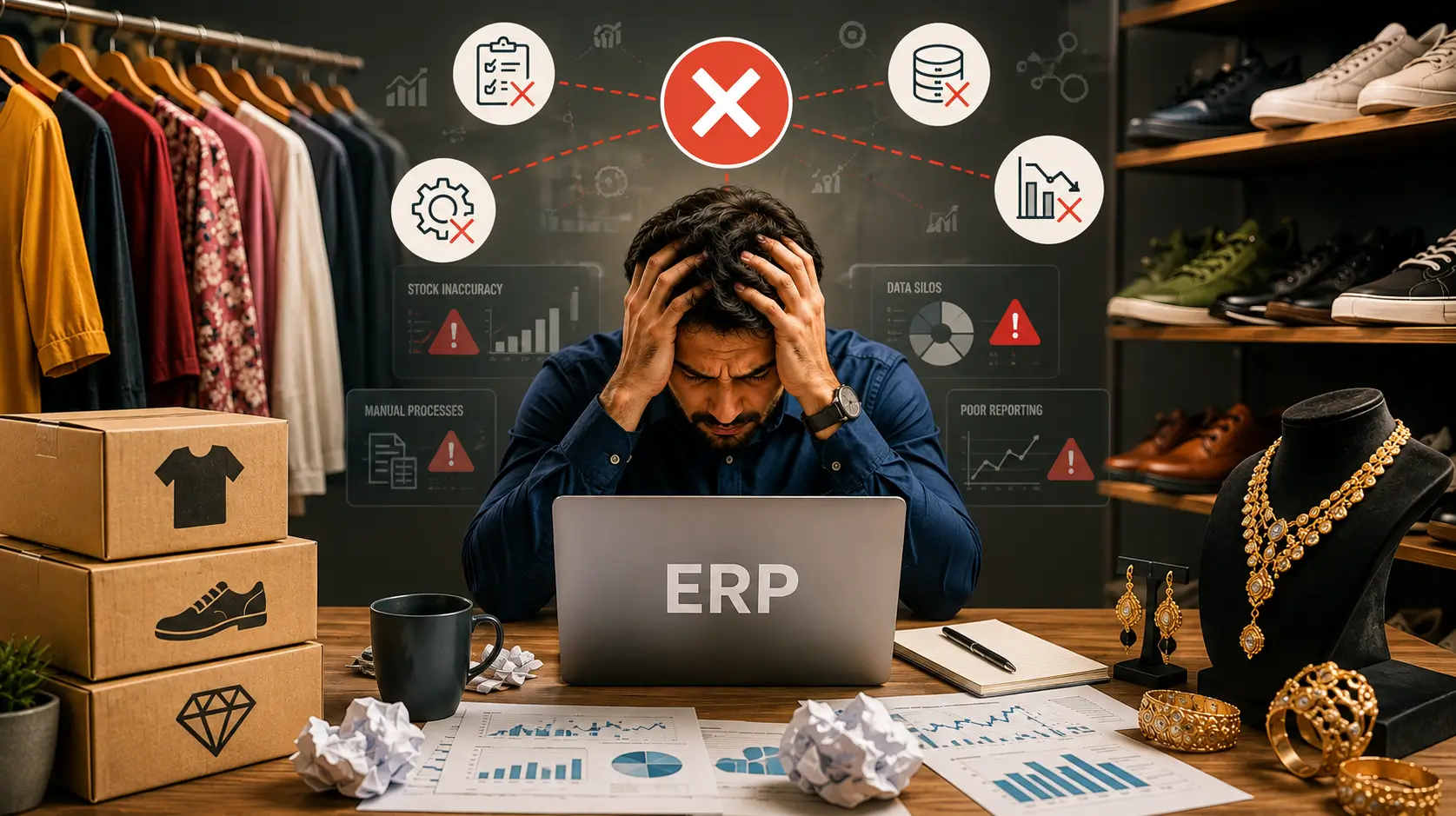
If you are running a business in India – whether it’s a jewellery showroom in Jaipur, a garment wholesale unit in Surat, a retail chain in Mumbai, or a food outlet in Ahmedabad – chances are you are managing multiple operations every single day. Stock, billing, staff, orders, GST returns, customer follow-ups. Most businesses handle all of this across spreadsheets, notebooks, and disconnected software tools.
That is exactly the problem ERP software solves.
In 2026, ERP (Enterprise Resource Planning) is no longer just for large corporations. It has become the operational backbone for thousands of small and medium businesses across India – and for good reason. This guide breaks down what ERP software actually is, how it works, and why your business needs it right now.
What is ERP Software?
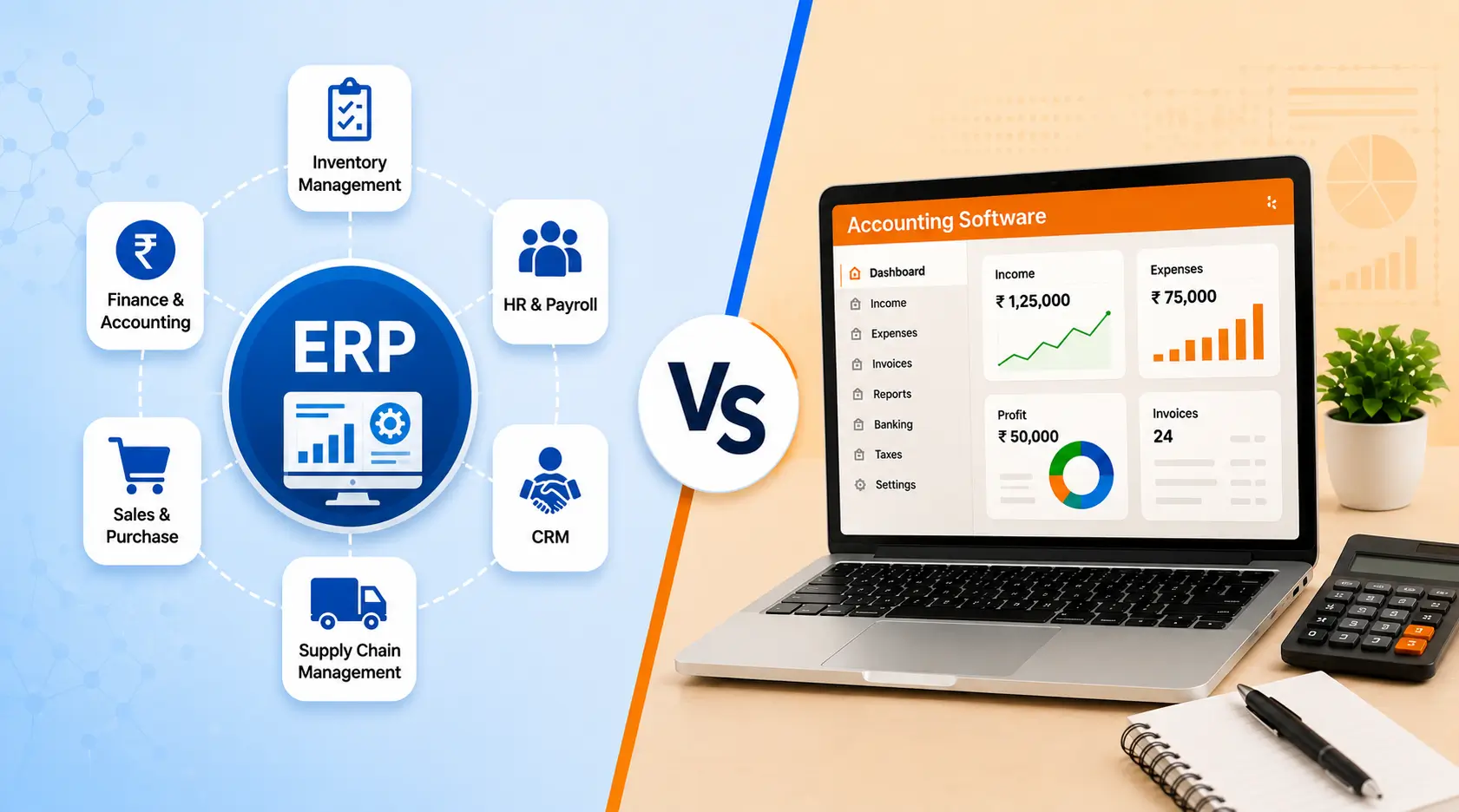
ERP software is an integrated business management system that connects all your core operations – inventory, sales, billing, purchasing, payroll, accounts, and customer management – into a single platform.
Instead of using one software for billing, another for stock, a third for payroll, and a spreadsheet for everything else, ERP brings all of it under one roof. Every department works from the same data, in real time.
Think of it this way: when a customer places an order, your ERP automatically updates inventory, generates a GST-compliant invoice, triggers a dispatch alert, and logs the transaction in your accounts – all at once, without anyone entering data twice.
In simple terms: ERP software is the central nervous system of your business.
How Does ERP Software Work?
A modern ERP system is built around modules — each module handles a specific business function. Depending on your industry, you activate the modules you need.
Common ERP modules include:
- Inventory & Stock Management – Track products by SKU, size, colour, weight, or purity across multiple locations
- Sales & Billing – Generate GST invoices, E-way bills, and manage customer accounts
- Purchase Management – Raise purchase orders, manage vendors, and track inward stock
- Accounts & Finance – Handle ledgers, payments, TDS, TCS, and GST reconciliation
- Payroll & HRMS – Process salaries, manage attendance, and stay compliant with PF, ESIC, and TDS
- CRM – Track leads, follow-ups, and customer history
- Reports & Dashboard – Get real-time insights on sales, stock, and profit
All these modules share the same database, which means no duplication, no data mismatch, and no manual reconciliation at month-end.
ERP Software in the Indian Business Context
Indian businesses face a unique set of operational challenges that make ERP especially valuable:
GST Compliance
Since the rollout of GST, businesses must maintain accurate HSN codes, manage multiple tax slabs, generate E-way bills for goods in transit, and file regular returns. Doing this manually or across disconnected tools leads to errors and penalties. A GST- Compliant ERP automates this entire process — from invoice generation to return-ready reports.
Multi-Location Operations
Many Indian retailers and wholesalers operate across multiple branches, warehouses, or cities. Managing stock transfers, inter-branch billing, and consolidated reporting manually is nearly impossible at scale. ERP gives you a single view across all locations.
Industry-Specific Complexity
Different industries in India have very different operational needs:
1. Jewellery businesses need to track gold and silver by purity (22K, 18K), manage Karigar (job work) accounts, handle old gold exchange, and comply with HUID hallmarking norms
2. Garment and footwear businesses need size-colour matrix inventory, season-wise collection management, and B2B order handling for dealers and distributors
3. Retail and food businesses need FIFO-based expiry tracking, recipe-level cost management, and real-time POS synced with central stock
Generic accounting tools are not built for any of this. Industry-specific ERP software is.
Why Does Your Business Need ERP Software in 2026?
1. Manual Processes Are Holding You Back
If your team spends more time entering data than serving customers, that’s a problem. Manual billing, stock counting, and report preparation are slow, error-prone, and expensive in terms of staff time. ERP automates repetitive tasks so your team can focus on growth.
2. GST and Compliance Complexity Is Only Increasing
With the government tightening GST audit mechanisms, e-invoicing mandates expanding, and E-way bill requirements becoming stricter, businesses that aren’t running a compliant ERP system are taking on unnecessary risk. A good ERP for Indian businesses keeps you audit-ready at all times.
3. Your Customers Expect Speed
In 2026, customers expect fast quotes, instant order confirmations, and real-time delivery updates. If your team has to manually check stock, calculate prices, and type out invoices, you are slower than your competition. ERP gives your sales team live inventory and pricing data so they can respond in minutes, not hours.
4. Growth Multiplies Complexity
A business doing ₹50 lakh a year can manage with Tally and a spreadsheet. A business doing ₹5 crore across three branches with 20 employees cannot. As you grow, the gaps in disconnected systems grow with you — and at some point, they start costing you money. ERP is what allows businesses to scale without chaos.
5. Data-Driven Decisions Require Real-Time Data
Which product is your best seller? Which branch is underperforming? Which customer hasn’t ordered in 60 days? Without ERP, answering these questions means pulling reports from multiple places and manually compiling them. With ERP, the answer is one click away — live, accurate, and actionable.
Industry-Specific ERP: Why One Size Does Not Fit All
A jewellery manufacturer and a garment retailer both need ERP — but they need completely different things from it.
This is why industry-specific ERP software exists. Rather than forcing every business to adapt to a generic tool, good ERP is built around the workflows, terminology, and compliance requirements of a specific industry.
At Alpha ERP, our solutions are built ground-up for the industries we serve:
- G-Soft ERP – Purpose-built for apparel, lifestyle, and footwear businesses managing multi-brand, multi-location retail and wholesale operations
- J-Soft ERP – Designed specifically for jewellery manufacturers, wholesalers, and retailers — handling gold/silver/diamond inventory, Karigar accounts, HUID compliance, and melting/wastage accounting
- Alpha Extreme – Built for retail chains and food businesses, with POS, FIFO stock management, expiry tracking, and multi-outlet reporting
Each of these is not a generic ERP renamed for an industry. It is a system built from 25+ years of working directly with businesses in these sectors across 400+ cities in India.
Cloud ERP vs Desktop ERP: Which Should You Choose?
This is one of the most common questions businesses ask when evaluating ERP for the first time. The short answer: it depends on your business size, internet access, and data security preferences.
We have covered this in detail in our blog post: Cloud ERP vs Desktop ERP: Which One is Right for Your Business?
What to Look for When Choosing ERP Software in India
Not all ERP software is equal. Here’s a checklist to evaluate any ERP solution:
| Feature | What to Check |
|---|---|
| GST Compliance | Does it generate GST invoices, E-way bills, and return-ready reports? |
| Industry Fit | Is it built specifically for your industry or is it a generic business software? |
| Scalability | Can it handle multiple branches, multiple users, and increasing transaction volumes as your business grows? |
| Ease of Use | Can your billing, sales, and warehouse staff use it without requiring weeks of training? |
| Local Support | Is there a reliable support team that understands Indian GST laws and local business workflows? |
| Integration | Can it integrate with WhatsApp, e-commerce platforms, payment gateways, accounting software, or your existing business tools? |
| Mobile Access | Can you and your team view reports, manage orders, and monitor business operations through a mobile app? |
For integration with WhatsApp automation, see how Alpha Chatbox connects with your ERP to send order updates, invoices, and customer communication directly on WhatsApp.
Real Impact: What Businesses Experience After Implementing ERP
Businesses that implement ERP typically report:
- 30–50% reduction in manual data entry and billing time
- Fewer stock discrepancies due to real-time inventory tracking
- Faster month-end closing because accounts and billing are always in sync
- Better GST audit readiness with accurate, auto-generated reports
- Improved customer response time because sales teams have live data at their fingertips
These are not theoretical benefits. They reflect what 5,000+ businesses across India have experienced after implementing Alpha ERP solutions over the past 25+ years.
See what our clients say about Alpha ERP
Frequently Asked Questions
1. Is ERP software only for large businesses?
No. Modern ERP solutions are available for businesses of all sizes, including small retailers, single-store jewellers, and regional wholesalers. Cloud ERP especially makes it affordable and accessible for SMBs.
2. How long does it take to implement ERP?
Depending on business size and complexity, implementation can take anywhere from a few days (for a single-store setup) to a few weeks (for multi-branch businesses with complex workflows). Alpha ERP’s implementation team ensures a smooth transition with on-site and remote support.
3. Will my team find it difficult to use?
Alpha ERP is designed for real business users – not IT professionals. The interfaces are built around the workflows your billing, store, and accounts staff already follow, minimising the learning curve.
4. Can ERP handle GST, E-way bills, and HUID compliance?
Yes. Alpha ERP is built for Indian compliance requirements including GST invoicing, multi-slab GST, E-way bill generation, HSN code mapping, and HUID hallmarking for jewellery businesses.
Conclusion
In 2026, running a business without ERP is like managing a growing city without traffic signals – it works until it doesn’t, and when it breaks, it costs far more to fix than the investment you avoided.
Whether you are in jewellery, apparel, footwear, retail, or food – ERP software is not a luxury. It is the operational infrastructure that lets your business run faster, stay compliant, and scale with confidence.
Alpha ERP has been building industry-specific ERP for Indian businesses for 25+ years, across 5,000+ clients in 400+ cities. Our solutions are not one-size-fits-all — they are built for the way your industry actually works.
Request a Free Demo Today and see how Alpha ERP fits your business.