





ERP vs Accounting Software: What’s the Difference?
If you run a business in India, you almost certainly started with accounting software. It handled your invoices, your ledgers, your GST returns – and for a while, that was enough.
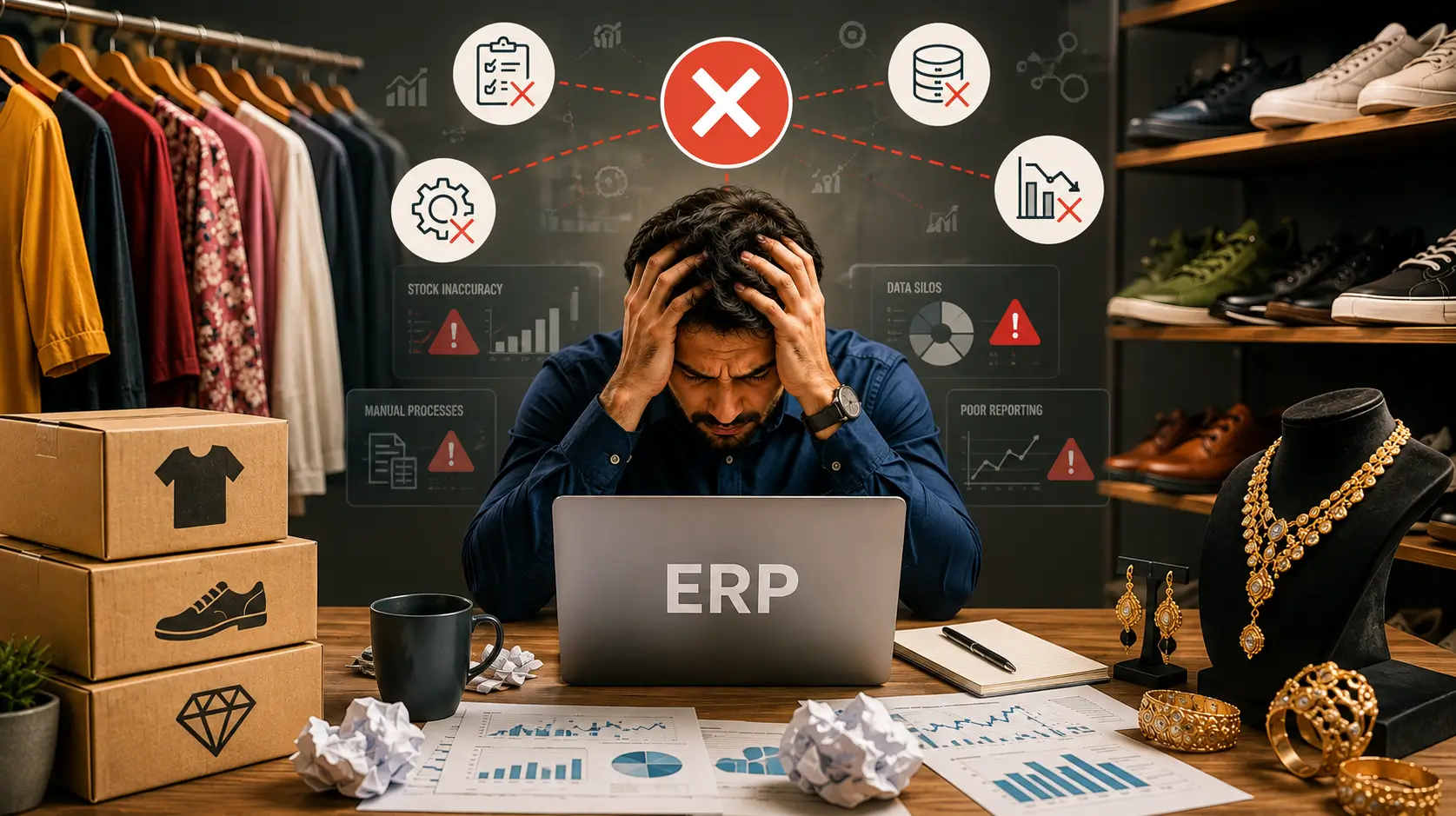
But as your business grew, you started running into problems. Stock mismatches. No visibility into which store was performing. Payroll done separately. Customer data in a different place. And reports that took hours to compile manually every month-end.
That is the moment most business owners start asking: what is the difference between ERP and accounting software – and do I need to upgrade?
This guide answers that question clearly, without jargon.
What Is Accounting Software?
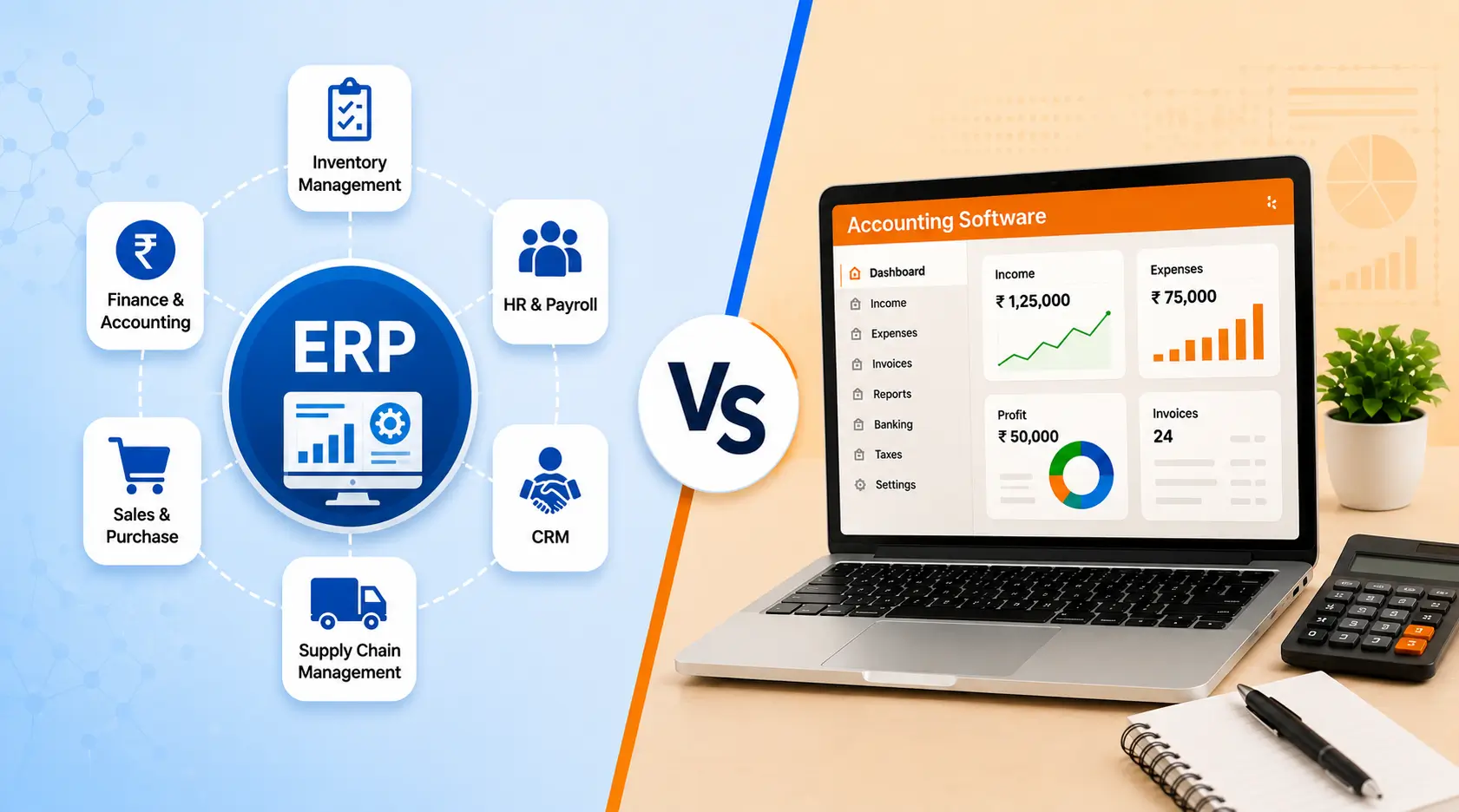
Accounting software is designed to do one thing well: record and manage your financial transactions. It tracks income, expenses, accounts payable, accounts receivable, and produces financial statements.
In the Indian business context, Accounting Software is the dominant accounting tool. It is reliable, widely used, and handles GST returns, TDS, and basic invoicing effectively
What accounting software does:
- Records sales and purchase entries
- Manages GST invoicing and return-ready reports
- Tracks bank accounts, receivables, and payables
- Generates profit & loss statements and balance sheets
- Handles TDS, TCS, and basic statutory compliance
What it does not do:
- Real-time inventory tracking by SKU, size, colour, or purity
- Multi-branch stock management and transfers
- Purchase order and vendor management workflows
- CRM and customer follow-up tracking
- Payroll, attendance, and HRMS
- Business intelligence dashboards with live data
- Industry-specific functions like Karigar accounts, size-colour matrix, or HUID compliance
What Is ERP Software?
ERP (Enterprise Resource Planning) software is an integrated business management system that connects all departments – inventory, sales, billing, purchasing, accounts, payroll, CRM, and reporting — into one platform.
Unlike accounting software which only sees your finances, ERP sees your entire business. Every transaction – a sale, a stock movement, a vendor payment, a staff attendance entry – flows into one connected system and updates all related records automatically.
ERP vs Accounting Software: Head-to-Head Comparison
| Feature | Accounting Software | ERP Software |
|---|---|---|
| GST Invoicing & Returns | ✓ Yes | ✓ Yes |
| Financial Statements | ✓ Yes | ✓ Yes |
| Real-Time Inventory Tracking | ~ Limited | ✓ Full SKU-Level Tracking |
| Size-Colour Matrix (Apparel) | ✕ No | ✓ Built-In |
| Gold/Silver/Purity Tracking (Jewellery) | ✕ No | ✓ Built-In |
| Multi-Branch Stock Visibility | ✕ No | ✓ Yes |
| Purchase Order Management | ~ Basic | ✓ Full PO Workflow |
| Payroll & HRMS | ✕ No | ✓ Yes |
| CRM & Customer Management | ✕ No | ✓ Yes |
| Barcode / RFID Integration | ✕ No | ✓ Yes |
| E-Way Bill Generation | ~ With Add-Ons | ✓ Built-In |
| Business Intelligence Dashboard | ✕ No | ✓ Yes |
| Mobile App Access | ~ Limited | ✓ Yes |
| Industry-Specific Workflows | ✕ Generic | ✓ Purpose-Built |
The Core Difference: Scope
The simplest way to understand the difference is this:
Accounting software tells you what happened financially. ERP tells you why it happened and what to do about it.
Accounting software shows you that sales were ₹45 lakhs last month. ERP shows you which product category drove that revenue, which branch underperformed, which styles are running low on stock, which customers haven’t reordered in 60 days, and which vendor deliveries are overdue – all from the same platform.
When Is Accounting Software Enough?
Accounting software is the right tool when:
1. You are a very early-stage business with simple operations – one location, one product type, minimal staff
2. Your primary need is GST compliance and basic bookkeeping
3. You have a small product range with no size or variant tracking needed
4. You are not yet managing multiple vendors, purchase orders, or inter-branch operations
There is nothing wrong with starting with Accounting Software. Most Indian businesses do. The question is knowing when you have outgrown it.
When Do You Need ERP?
You have likely outgrown accounting software when:
1. Your inventory is inaccurate If your physical stock doesn’t match your system stock regularly, accounting software has hit its limit. It was not designed for real-time inventory management at the SKU level.
2. You are managing multiple branches or godowns Accounting software has no concept of multi-location stock. As soon as you open a second store or warehouse, the complexity exceeds what it can handle.
3. You need to track variantsGarment businesses tracking size-colour matrices, jewellery businesses tracking gold by purity and weight, footwear businesses tracking pairs and size runs – none of this is supported by standard accounting software.
4. Your month-end is a nightmare If reconciling accounts, inventory, and payroll at month-end takes more than a day and involves pulling data from multiple tools, you need an integrated system.
5. You have no visibility into business performance If you cannot answer “which product is my bestseller this week” or “which branch has the highest margin” without manually pulling and compiling data, you are missing the business intelligence that ERP provides.
💡Still on Accounting Softwareand feeling the gaps? Alpha ERP is used by 5,000+ businesses across India who made the switch – across apparel, jewellery, retail, and food verticals. Request a Free Demo →
Why Indian Businesses in Apparel, Jewellery & Retail Need ERP Specifically
Generic accounting tools are not built for the operational complexity of India’s largest retail industries:
Garment and footwear businesses deal with size-colour matrix inventory, seasonal collection management, inter-store stock transfers, job work with contractors, and B2B wholesale orders – none of which Accounting Software handles natively.
G-Soft ERP is built specifically for this industry, with barcode integration, size-colour stock grids, multi-branch POS, and EOSS (End of Season Sale) planning tools.
Jewellery businesses must track gold and silver by purity, weight, and making charges, manage Karigar (job work) accounts, handle old gold exchange transactions, comply with HUID hallmarking, and manage diamond and studded jewellery inventory separately.
No accounting software in India handles this. J-Soft ERP is purpose-built for it.
Supermarkets and food businesses need FIFO-based expiry tracking, recipe-level cost management for food outlets, real-time POS synced with central inventory, and multi-outlet reporting. These are ERP functions, not accounting functions.
ERP vs Accounting Software: The Most Common Question in India
Accounting Softwareis not an ERP. It is an accounting tool with some inventory add-ons. This is not a criticism – it is simply what it was designed to do.
The confusion arises because Accounting Softwareis so widely used in India that many business owners assume it is the complete solution. It handles GST well. It handles ledgers well. But it does not handle:
- Real-time multi-branch stock management
- Size-colour-style inventory matrices
- Integrated payroll and HRMS
- CRM and customer lifecycle management
- Industry-specific workflows for apparel, jewellery, or food
When should you stick with Accounting Software? When you need accounting and GST compliance only, and your operations are simple.
When should you move to ERP? When your operations have grown beyond what Accounting Softwarewas designed to manage.
Many businesses actually run both – Accounting Softwarefor statutory accounts and ERP for operations – but this creates double data entry and reconciliation headaches. An integrated ERP eliminates the need for both.
Can ERP Handle GST and Compliance Like Accounting Software?
Yes — and in most cases, better.
A modern GST-compliant ERP like Alpha ERP handles:
- Multi-slab GST invoicing with correct HSN codes
- E-way bill generation directly from the ERP
- GST return-ready reports (GSTR-1, GSTR-3B)
- TDS and TCS compliance
- Audit trail for all transactions
The difference is that ERP does this as part of a connected workflow – the GST invoice is generated automatically when a sale is entered, inventory updates simultaneously, and the transaction posts to accounts without anyone touching it twice.
Making the Switch: What to Expect
Moving from accounting software to ERP does require some investment – in the software itself, in data migration, and in staff training. But the businesses that make this transition consistently report:
- Faster billing and fewer errors at the counter
- Accurate inventory without monthly manual counts
- Payroll and accounts processed in hours, not days
- Real-time visibility into business performance across branches
- Dramatically reduced month-end reconciliation effort
Frequently Asked Questions
1. Is ERP more expensive than Accounting Software?
ERP typically has a higher upfront cost than accounting software, but the ROI from accurate inventory, reduced data entry, and integrated operations usually pays for the difference quickly. Cloud ERP options have also made ERP much more affordable for SMBs.
2. Can I import my Accounting Softwaredata into Alpha ERP?
Yes. Alpha ERP supports data migration from Accounting Softwareand other common accounting tools during the onboarding process.
3. Do I still need a CA or accountant if I use ERP?
Yes – ERP handles bookkeeping and compliance reporting, but professional advice on tax planning, audits, and statutory filings remains valuable. ERP makes your accountant’s job easier by giving them clean, accurate data.
4. Is ERP suitable for a small business with one store?
Absolutely. Many Alpha ERP clients started with a single store and scaled to multiple branches on the same system. Cloud ERP plans are designed to be affordable at the single-store level.
Conclusion
Accounting software and ERP solve different problems. Accounting software records what happened financially. ERP manages how your entire business operates — and connects finance to inventory, sales, purchasing, payroll, and customer management in real time.
For Indian businesses in apparel, jewellery, retail, and food – where operational complexity is high and GST compliance is non-negotiable – ERP is not an upgrade. It is a necessity.
Alpha ERP has been helping Indian businesses make this transition for 25+ years, with industry-specific solutions built for the way your business actually works.